21 October 2021/Lauri Ilison
Finnish speech-to-text accuracy for call centres
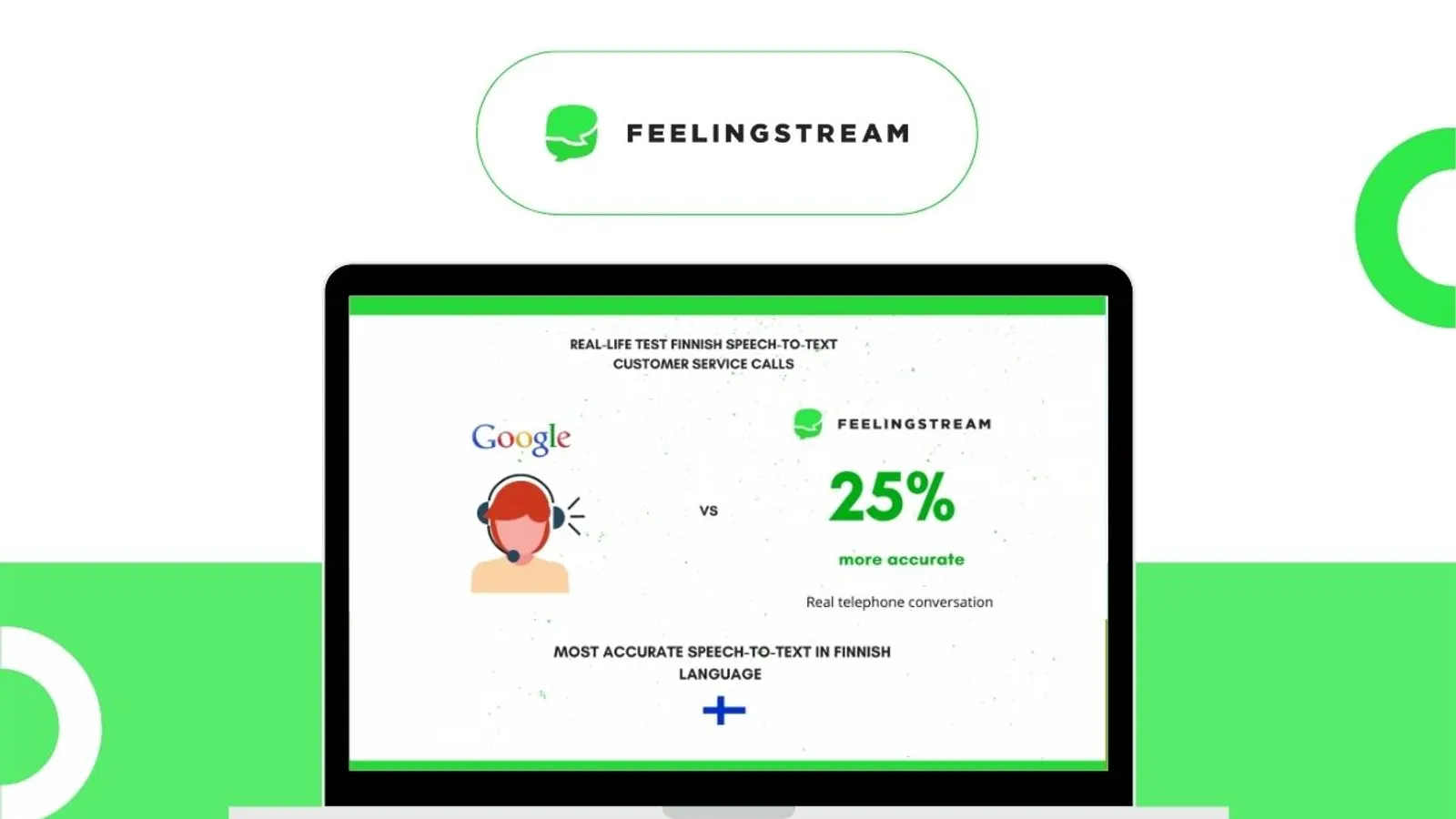
For English, automatic speech recognition (ASR) is very good — the best engines report accuracy in the region of 95% on clean audio. Finnish is a different proposition. It is morphologically complex and heavily inflected, with many forms for a single word, which makes transcription harder. Add the realities of a phone call — background noise, people talking over each other, no scripts — and the job gets harder still.
That gap matters for any Finnish contact centre that wants to analyse its calls. Generic, publicly available models are trained largely on clean, widely spoken audio; they are not built for spontaneous Finnish spoken down a phone line. This is the specific problem Feelingstream set out to solve, and it is worth understanding why domain-tuned ASR outperforms general-purpose engines here.
Why is Finnish hard to transcribe?
Two things stack up against a generic engine:
- Linguistic complexity. Finnish inflection produces a huge number of word forms, so a model needs far more exposure to the language to transcribe it reliably.
- Real-world audio. Most ASR is evaluated on tidy recordings, not calls with a child in the background, traffic noise, or crosstalk. Contact-centre audio is exactly the messy case generic models handle least well.
A model trained specifically on spontaneous Finnish phone calls learns both the language and the conditions, which is why it can pull ahead of a general engine on this narrow but important task.
How does domain-tuned Finnish ASR compare?
To understand where its own model stood, Feelingstream tested it against the publicly available Google and Azure engines on realistic material rather than studio audio.
The test set-up:
- 20 recordings, with agent and customer captured on separate channels.
- Demo calls made by Feelingstream staff to Finnish service providers across transport, banking, pension, telecom and insurance.
- Native-level Finnish speakers.
- A median call length of around 151 seconds.
- Spontaneous calls with no scripts, made from an office on ordinary phones with no special equipment — so the recordings carried genuine background noise.
On that spontaneous phone-call material, the Feelingstream model transcribed more accurately than both generic engines — reportedly around 20% more accurate than Azure and around 25% more accurate than Google.
The headline figure is less important than the reason behind it: a model built for spontaneous Finnish phone calls beats a general-purpose one on exactly that task.
Why use ASR for contact-centre calls at all?
A large contact centre handles thousands of calls a day. Without transcription, managers are trying to judge quality, spot service issues and find cost savings from a tiny, unrepresentative sample. Transcribing calls to text turns that audio into data you can actually analyse, giving real visibility into the day-to-day.
Two practical reasons to favour a private, adaptable model over a public one:
- Adaptability. Public Finnish models are moderately accurate but cannot be tuned to your company's vocabulary, products and dialects.
- Confidentiality. Call contents are often sensitive, so sending them through a public model or shared infrastructure is frequently not an option.
Once calls are text, teams find their own uses on top of the transcription — management reviewing process timelines and statistics in meetings, or a telecom tracking contact reasons tied to a specific subcontractor to monitor issue volumes.
What makes a strong Finnish ASR model for call centres?
For contact-centre use, look for:
- High accuracy on spontaneous speech, not just clean audio.
- Training focused on customer service calls in Finnish.
- Coverage of regional dialects.
- Speaker separation, so agent and customer can be searched independently.
- Punctuation and capitalisation, which make transcripts readable and help the downstream analysis.
- An API and real-time transcription option.
- Deployment on-premises or in a private cloud, so sensitive audio stays secure — see data security.
Frequently asked questions
Why is Finnish harder to transcribe than English?
Finnish is highly inflected, producing many forms of each word, and it has fewer speakers, so generic models see less training data. Combined with noisy phone-call audio, that makes accurate transcription more difficult.
Why not just use Google or Azure for Finnish calls?
Public engines are moderately accurate but cannot be adapted to your vocabulary and dialects, and routing confidential call audio through shared infrastructure is often not acceptable. A domain-tuned, privately deployed model addresses both.
Does the model separate speakers?
Yes. With agent and customer on separate channels, the transcript keeps speakers apart, which enables speaker-based searches and cleaner analysis.
Can it run without sending audio to a public cloud?
Yes. The model can be installed on-premises or in a private cloud, keeping sensitive call recordings within your own environment.
Where to go next
- Understand the discipline: What is conversation analytics?
- Explore the technology: Multilingual speech-to-text
- Keep data secure: Data security
- See it in practice: Use cases
Want to see how accurately your Finnish calls transcribe — on your own audio? Book a demo and we will run it on real recordings from your contact centre.